

JOURNAL
A space for the quiet thoughts that surface while I paint – reflections on landscape, process, colour and the subtle moments that often go unnoticed. These Journals are the fragments gathered in the studio and in the field, where observation deepens and the work slowly reveals itself.
Journal #17
SEARCHING
I still don’t consider myself an abstract artist – that would be pushing it, as true abstraction requires the ability to delve far deeper into the subconscious. I am not at that point, I’m not even sure I want to be. Instead, I see myself as a semi-abstract artist, searching to fit into a place somewhere between reality and abstraction. My intention is to distil elements of the world around me, to capture the essence of being within a landscape and revisit it through memory, feeling and association. Why? I cannot fully answer that, only that the need to do it is there.
Read more...
As I mentioned in an earlier journal, some paintings seem to find their own rhythm almost immediately, while others resist, asking for more patience and persistence. Over the years I have learnt that by simplifying the values, a painting often gains greater clarity and presence. Light begins to sing against shadow, contrasts awaken the surface, and the eye is invited to wander, pause and return. It is often through this balance of simplicity and contrast that a painting finds its greatest strength. I have learnt that there has to be a ‘quiet’ place – a place to rest and ponder before moving towards the contrasts of complex detail.
With each brushstroke, each scratch into the surface, each mark subconsciously added, the composition slowly begins to reveal itself – not fully formed, but emerging through a process of reimagining, reshaping and responding. A landscape is not simply painted; it is discovered, one mark at a time.
Even when I’m not happy with a piece, I rarely throw anything away. Over the years I have found that reworking a surface creates texture, thickness, a history within the painting itself, it evolves into a ground to excavate into, to work more physically upon. It holds its own history. Hidden marks from previous layers sometimes rise back to the surface, these are traces of time captured within the process of not being too precious. But I also enjoy working in a more simplified way using limited materials and restrained mark-making, where a piece can be just as striking, just as intentional, yet still sympathetic to the story being told. I have tried numerous materials but favour the ones that work for me – keeping it simple.
One of my go-to combinations, especially when I want to loosen up or explore colour relationships and composition is working with Indian ink and charcoal, sometimes finishing off with touches of oil pastel. More often than not, I limit myself to no more than two colours. I find this removes much of the pressure around values, allowing me to focus instead on contrast, atmosphere and the essence of what I am trying to express. These works are rarely shown publicly, they sit quietly in my plan chest or sketch books for reference only.
I am always searching to conjure up a feeling, an atmosphere within each piece. Going beyond recognisable forms within the landscape, exploring form, colour values and expression is my way of helping expand our understanding of the world. I don’t want to capture everything there – just fragments we miss.
Abstract art is challenging but everything is ‘abstract’ in reality. It opens the mind to free expression and invites us to see beyond what is immediately visible. For me, it is relational – a conversation with the world and everything within it. It begins by finding something worth abstracting, then exploring the possibilities that resonate until an idea slowly transforms into something entirely of its own.
I have little interest in simply representing the visible, because that already exists. What excites me is the search for something new, something unexpected and unique. I am drawn to creating a sense of place, memory or feeling within the landscape rather than a literal depiction; making something that could not be expressed in any other way. It is in that transformation that the real discovery lies.
Quote: ‘There are enough tables and chairs in the world so there is no reason to paint them. The challenge now is to actually work with painting in such a way that you are making something very specific to painting that no other media can do’. Ian McKeever – artist
Journal #16
EXPECTATIONS
For me, being an artist is not simply a profession – it is a way of being. It shapes how I move through the world, continually shifting my perspective and inviting me to notice what might otherwise go unseen. I believe it is a calling; a means of translating experience, memory, emotion and observation into something tangible. Art becomes a visual diary – a place where fleeting moments are gathered, where curiosity and memories settle like layers of paint, and where the ordinary is given space to breathe. It is my way of making sense of the world while offering a personal response back to it.
Read more...
As Pablo Picasso once said, “The problem is how to remain an artist once he grows up.” Or, she, I would like to add!
Perhaps that is both the challenge and the gift of continuing to create: to hold on to curiosity, to protect our sensitivity, and to have the courage to keep looking, questioning and making. To preserve that childlike wonder which so often fades beneath the demands of adulthood.
I cannot tell you how many times I was caught daydreaming throughout my school days – gently reprimanded for not paying attention, when in truth I was paying attention in the only way I knew how. I was simply curious, absorbing the shifting light, listening to the outside, watching people, noticing patterns and possibilities. So curious, in fact, that I would often wander off, returning with pockets full of bric-a-brac, fragments of nature, curious fauna and flora, weathered objects, flotsam and jetsam that most people would simply walk past. I have always been drawn to the overlooked, the forgotten, the things that quietly whisper their own stories. I used to love hiding things in boxes and tins – they were my pieces of worldly treasure. It is still the unknown that excites me; the possibility of discovering something unexpected.
Looking back, I now realise those quiet moments of wandering thought were not distractions at all. They were the beginnings of the artist I was yet to become.
That same curiosity follows me into the studio today. I relish the uncertainty of beginning a new painting. Rarely do I have a fixed destination in mind – some loose sketches or a faint memory to guide me but that’s all. Then the first marks are made, and something shifts. The studio comes alive. The paintings begin to reveal themselves, almost as though they have been waiting patiently to emerge.
Of course, intuition alone is never enough. Every piece of artwork presents its own set of technical questions, and for me there are two enduring principles that underpin the process of resolving them – composition and value. They become the quiet structure beneath the freedom, allowing instinct and observation to find their balance. Just like the balance in nature, which is a fluid, ever-shifting state of constant adjustment. “When we see land as a community to which we belong, we may begin to use it with love and respect.” – Aldo Leopold
Experience has allowed me to realise that creativity lives within the act of making. It is in the doing, rather than the thinking, that ideas begin to breathe. Yet, it is often taking those first few steps that presents the greatest challenge but challenge is good as it often reveals unexpected results. Describing it to when I’m out painting plen aire – I never know what the outcome will be as there are so many variables but its the ‘play’ element that drives the work on.
On that note, I know that I don’t play enough. It is often in play – free from expectation and self-judgement that the most exciting and unexpected discoveries are made. Those moments of curiosity, experimentation and happy accidents can lead to places no amount of planning could ever reach so why don’t I do it more often? Perhaps my goal this year should simply be to let go of expectations, to trust the process more, to allow myself the freedom to play.
Sometimes I long to become that child again – the one who wandered without purpose, collected forgotten treasures, and marvelled at the smallest details. But perhaps the goal is not to return to childhood but to reclaim that sense of wonder; to nurture a way of seeing that remains curious, open-hearted and alive.
After all, isn’t that what being an artist asks of us? Not to know all the answers, but to keep looking, keep wondering, and to trust that the next brushstroke might reveal something we never expected to find.
Journal #15
INSTINCT
Sometimes instinct tells me to run away from art altogether. I often find myself questioning why I am doing this, who it is for and what it all means. Yet perhaps those questions are part of being an artist, part of remaining open and searching.
Read more...
As I mentioned in my last journal, making art for me is not about certainty or perfection – I hope I never arrive at either, because then there would be no goal, no drive, no spirit left in the making. For me, it is about showing up, questioning, responding, exploring new ideas and pushing boundaries I did not know existed through the instinct of making. It is about life itself.
If we do what we love, then our art inevitably becomes personal, a reflection of who we are, our experiences, our thoughts and the way we move through the world. I have come to see art not simply as something we produce, but as a way of living, a way of deepening the mystery and understanding myself more fully through hand, head and heart. As Ai Weiwei said, “Life is art. Art is life. I never separate it.”
In the last ten years I have chosen to push the boundaries of a 2dimensional practice, primarily concentrating on painting, whilst occasionally expanding into drawing and collage. My work is mainly created using acrylics, or oils combined with a cold wax medium, layering with drawing materials. I have always preferred working in multiples, developing paintings as part of a series. For me, working this way removes the pressure of focusing on a single piece needing to be a success. Is this wise! I don’t know! I just know it feels natural and right.
This is a topic often voiced by clients during my workshops, where the pressure they place upon themselves becomes so overwhelming they stop painting altogether, finding it difficult to regain the motivation to begin again. I share the importance of enjoying the process, to stand back, observe, walk away and then return with fresh eyes. Only then can you truly see what needs changing, or perhaps what does not.
I find by working in multiples – this can be just two paintings at a time – it allows space for broader experimentation, discovery, where unexpected results emerge naturally through process. There is a freedom in moving between works, where ideas evolve organically and begin to inform one another. Often, there is one painting that rises above the rest. It brings a sense of clarity and hope, and I never fully understand why that particular painting works, it simply does. Value, contrast, saturation and composition somehow come together in harmony, arriving at a point where the painting feels complete and ready to go out into the world.
For the other work, there may be just a touch of too much intention or overworking. Sometimes they sit too close to one another and need more space to transmit their own message and identity. Painting is both skill and imagination, but also sensitivity, learning to trust what you see and feel. I am no expert in this minefield of expression but everything around me teaches me about being better: by looking, observing, noticing form, atmosphere, rhythm and light. Art arises from lived experience, and I am naturally drawn to artists who are able to express that experience openly, honestly and without pretence.
I must add, the process of creating one piece at a time can feel daunting in any medium. The work somehow becomes heavy – not literally, but emotionally, laden with expectation and the pressure to resolve everything within a single piece. Some artists thrive working this way, but it has never felt natural to me, unless I am presenting demonstrations or leading a workshop. In those situations, the pressure is different as the painting is understood as part of a ‘work in progress’ rather than a resolved final piece. It becomes more about exploration, instinct and responding in the moment, relying heavily on intuition.
As Henry Moore once said, “To be an artist is to believe in life.”
Art does not always lead with clarity or certainty, but it continues to excite me, shift my perspective, and push me forwards, reminding me that making art is less about having answers and more about remaining curious enough to keep searching.
Journal #14
TRANSPARENCY
Through sharing these journals with you, writing openly about my experiences as an artist, I feel a sense of importance to be totally transparent about more than simply the making of the artwork itself, but also behind the scenes, because it is all interconnected. There is no real separation between the mindset involved in creating the work to the experience of presenting it publicly — every step requires vulnerability and exposure.
Read more...
In many ways, it feels like peeling back layers of myself as an artist. The physical work, the hidden words, the exhibitions, the frustrations, all these personal experiences become part of the same reflection. By writing things down, I am revealing something of myself as the artist, a sharing process that I hope you enjoy reading. But perhaps these journals will never be read, or understood but that’s ok, because the process of putting thoughts into words – despite the laptop replacing pen and paper – has become deeply cathartic for me. Writing allows me to pause, reflect and make sense of living as an artist.
Firstly, I think the motivation to record a life’s journey helps navigate the often solitary world we find ourselves working within. In many ways, writing has become an important part of my creative process itself – a quiet space for reflection, honesty and understanding. How lovely if one day the words were compiled and accompanied my paintings in an artist book! Well, one can dream!!
As I sit here in my studio typing, there is a lingering sense of guilt for not holding a paint brush in my hand. Yet again, I find myself in that familiar space that follows the intensity of preparing for an exhibition. Finishing off artwork, framing, labelling, packing, setting up, exhibiting, interacting, taking it down, unpacking and finally, trying to process and evaluate everything that just happened.
After weeks of constant movement and momentum, there suddenly comes a stillness – a quiet that echoes into reflection. Maybe that is why I find myself writing instead of painting. It’s like a ‘rehabilitation of time’! I now understand this period has become my way of slowing down, of processing the experience, maybe even a form of procrastination (I do like a distraction), I guess it’s my form of recovery.
Artists often use humor and irony to address procrastination, viewing it as a creative delay or a necessary prelude to last-minute inspiration. Quote: “Only put off until tomorrow what you are willing to die having left undone,” Pablo Picasso
So, it is good to understand that the creative life is not only about making the work itself; it is also about navigating the emotional and physical exhaustion that can follow the vulnerability of sharing it with the world. Gentle recovery is key.
Secondly, I have always worked best with a sense of purpose and direction. I thrive on having deadlines to work towards, goals to focus on and challenges that push me forward creatively. I don’t know why but time pressures, although sometimes stressful, motivate and give structure to my practice.
I realise I do not work well in a place of uncertainty or creative drift, which is why I constantly set myself new aims and projects. Some may feel ambitious or demanding, but most are achievable and help keep momentum alive. Without those personal goals, I feel untethered creatively. The challenge itself becomes part of the motivation to continue evolving and making the work – that’s when I’m in my happy place.
Quote; I am not going to show you my art. I am going to share it with you. If I show it to you it becomes an exhibition, and in time it will be pushed so far into the back of your mind that it will be lost. But by sharing it with you, you will not only retain it forever, but I too will improve – Ed Parker
Above all, I try to remain honest and transparent in the way I share both my work and my creative practice. Painting, for me, is not about certainty or perfection and I hope I never get there because then, there is no goal! It’s about showing up, questioning, responding and continuing to learn through the act of making and being thankful for this gift.
If these words resonate with someone searching for clarity, reassurance or simply the courage to keep showing up as an artist each day, then they have been worth writing.
Journal #13
REFLECTIONS
I have always believed it is important to be open and honest about the realities of being an artist, so here are a few reflections on exhibiting at Art Fairs.
Read more...
As I have mentioned before, they are not for the faint-hearted. I remember someone once saying, “Art Fairs are not about making money – they are about making connections.” There is truth in that. They are places where conversations begin, where work finds its audience, and where unexpected opportunities can quietly unfold. Yet the reality is that we also need to cover our costs, to earn enough to keep creating, and, if we are fortunate, to catch the eye of a gallery that recognises something of value in our visual language.
It brings me back to that recurring question – why do we make art?
For me, paintings are not meant to remain hidden in the shadows of a studio, waiting to be discovered long after the artist has gone. They are made to be seen, to be shared, to spark recognition or curiosity in another. Each one becomes a marker along the way, a fragment of experience, a trace of light, a memory held in paint. In that sense, every painting records a passage of time, not only in the landscape before us, but within ourselves.
Still today, I find myself quietly asking ‘do I want to keep putting myself through the vulnerability of presenting my work in this way’! My most recent experience was somewhat disappointing. It’s hard to explain why visitor numbers were noticeably down, which inevitably affected morale and of course sales. Thankfully, I covered my costs on the first day, after that, things gradually slowed and by the third day it had become apparent people either did not know the event was happening. The reality is that not every Fair, Exhibition or Show will be a great success. Over time you learn to accept that there are many variables beyond your control – challenging weather, competing events, poor advertising, venue choice, limited accessibility or high entry costs that can influence attendance and engagement.
Despite these challenges, there were positives to take away. I made some new connections and received commission enquiries. For me, selling work to new collectors is deeply rewarding because it means someone has genuinely connected with my visual language and the work I create. Equally special are the returning customers who seek me out year after year. There is always a wonderful sense of excitement when they find my stand – a shared recognition and enthusiasm that reminds me why I continue to do this. Knowing that someone wishes to live with another piece of my work is something I never take for granted, and those moments remain the most rewarding part of the experience.
Saying all this, I am excited for the next two events I have committed to this year. Both very different but where I have shown before and therefore, know what to expect which takes the pressure off. It’s now for me to make them work – to make exciting new work – to promote them professionally and above all, to be present!
One of the positives that comes from these experiences is talking to fellow artists. Sharing the same realities of everyone’s creative journey was invaluable. Listening to different experiences, conversations and knowledge gives a genuine sense of solidarity within the artistic community. As creatives, we all need encouragement and support, and having collectively experienced the highs, lows and challenges of this profession, I am always happy to share what I have learnt growing as a professional artist – with a few laughs along the way and a couple of glasses of fizz to help keep us all grounded and sane, we survive to carry on.
“Inspiration exists, but it has to find you working.” – Pablo Picasso
I continually remind myself that it is important to enjoy the experience – not to take everything too seriously, but instead to remain open to new connections, new conversations and new perspectives. Art is not always there to be fully understood by everyone. It can still move people, forge new friends, create exciting collaborations and nourish the soul simply through being present, keep working and be seen.
I often think back to something one of my university lecturers once said: ‘There is little point in making art for it only to be kept hidden away in a cupboard’.
Art deserves to be seen – to ignite discussion, invite debate and evoke emotion. Whether loved, questioned or interpreted differently by each viewer, it is through sharing the work that it truly begins to live beyond the studio walls.

Journal #12
AUDIENCE
I open this Journal with the question ‘who am I making my work for’? If it were only for myself, that would be enough – but in truth it feels like something more. Painting is a way of sharing experience, of expressing life through a visual language that touches on identity, both personal and collective.
Read more...
Each year I set myself new goals – small markers that encourage me to keep moving forward. I set deadlines and imagine ideas that may not always be reachable, yet the act of striving towards them is what drives the work forward. I cannot paint without purpose; there is always something I am trying to say, something that needs to find its way into the world. The question then becomes – who is the audience for this conversation?
For the past few months I have been finishing a series of paintings in preparation for Fusion Art Fair, Chester. It feels good to be painting again, to return to the rhythm of making. As Fusion is a new event, there are some levels of apprehension – who the audience might be – what kind of work will resonate etc. Alongside the creative drive is the practical reality of exhibiting. Taking part in an art fair requires commitment – time, preparation, a level of professionalism and, of course, financial investment. Materials, travel, food, parking, the countless small costs that gather around an event.
At the end of the day, I need to cover these costs and hopefully, make a profit to be able to continue painting, and yet beyond the practicalities, remains the deeper motivation: the need to continue making the work and sharing it. Trusting that somewhere it will connect with someone who recognises something of their own experience within it. Because of this, I became increasingly aware of a quiet need to ‘anchor’ the work to particular sites — places that hold personal resonance, where memory becomes a thread of connection. Even in the smallest remnants — fragments that persist within the landscape — there is a sense of continuity. It felt important to respond to these passing elements, to acknowledge a terrain so deeply layered with history and significance within my own environment in the North West.
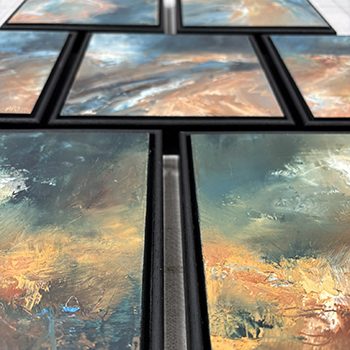
The semi-abstract paintings emerged as sensory impressions of being within the landscape itself — an attempt to trace the marks we leave behind, both visible and intangible — forming compositions that carry an energy, yet remain held within a quieter, more poetic register.
Quote; “Art is a vocation in life. It’s not a job. It’s not a career. It’s not about money. It’s something you feel you have to do and you can’t stop yourself from doing it”. – Tracey Emin
Some experienced advice would be, when applying to events, be selective, be picky! The reality is you have to do your homework on where your work sits best. I have learnt this the hard way and by understanding the possibilities of acceptance, but also, by accepting there are no guarantees your work will be noticed within the diverse world of competitive art.
The whole preparation and commuting to exhibitions is exhausting, I could not do it without moral and physical support. The work involved in participating in an event takes commitment alongside running a studio. Not to mention the effort it takes applying to relevant galleries, hoping to be noticed. After years of rejection and celebratory successes, I have come to terms with – not everyone gets that BIG break – you need continued self belief. Keep doing what you do best – continue being creative-stubborn-different-driven-compassionate-emotional and unique, but above all be authentic.
I am represented by an Art Gallery in the centre of Liverpool, Dot-Art which has brought different opportunities to my practice. Art galleries need us equally as much as we need them- without us artists, there would be no galleries or exhibitions etc. https://dot-art.co.uk/product-category/amanda-oliphant/
So, I close this journal with a moment of self-observation. There are quieter days — times shaped by reflection and doubt — yet they are outnumbered by those that lift and reaffirm, reminding me why I continue making art, regardless of frustrations, uncertainties, or feelings of being misunderstood. All I can hope for is the satisfaction in trying with elements of daring to fail continue to inspire me.
Journal #11
IDENTITY
I touched briefly in my last Journal on the importance – for me – of remaining open to new experiences: exploration, experimentation and the willingness to keep writing. One thing I often say is, “the day I stop exploring is the day I will stop being an artist.” It is something I feel passionate about, because for me being an artist is not simply what I do – it is who I am.
Read more...
As Henry Moore once said: “There’s no retirement for an artist, it’s your way of living so there’s no end to it.” That sentiment resonates strongly with me I think because I see myself as that crazy lady in a large floppy straw hat painting at the bottom of my garden – it is a vision I often have! – it makes me smile.
Artists are often portrayed as somehow ‘privileged’, dismissive of reality or as creative do-gooders and time-wasters – people who are avoiding getting a ‘proper’ job. This is a grey area I wrestle with. Even today, I am questioned as to what I do and why I do it. I know these concerns come from a place of care – because choosing to be an artist can mean living with financial uncertainty and rejection, but that’s my choice, my identity.
The concept of being a creative person applies to all art industries, music, acting, writing – none are for the faint hearted as rejection can be brutal. Surely, in the end, it is for each individual to remain true to themselves and to follow their instinct – their calling – if they are able.
Quote; “The artist’s job is to be a light in the darkness and a voice in the silence.” – Oscar Wilde
The probability is that I will never “make it big” – at least not in my lifetime – but that’s not something I think about. But art is the first thing I think about when I wake in the morning, and the last thing I try to quieten in my mind when sleep eventually comes. Often, of course, it is the very thing that keeps me awake.
My work shifts and evolves as I do – it is a constant process of searching and uncovering, like excavating something long hidden. Often it feels as though I am digging towards the unknown, towards something that has not yet been said, not yet been made. Only recently have I begun to recognise that in this process I am also unearthing fragments of my own identity. The sense of who we are is built from the quiet archiving of memory. Many of these memories are vivid in childhood, later settling into the fabric of our personal history. They remain there, waiting to be revisited, reflected upon, and gently drawn back into the present.
Poem; The Mosaic of Me
Not just the label they placed on my skin, But the depth of the world that I carry within. Caught between echoes of what used to be, And the unfolding, untamed, present-day-me. – Yashwitha Yadav
History is complex, and my own experience of displacement takes me back delving into memories – a ‘self portrait’ of oneself. Memory is always subjective because it records how we feel, they are not facts, just fragments of identity.
When I paint a landscape, I feel as though I am delving into the subconscious – an archive of images quietly stored away. Fragments begin to surface. I am never quite sure where they come from, only that I recognise a connection to the landscape itself. Something underpins the brushstrokes – the colours, the tones – a process of probing, questioning and searching that happens almost unconsciously across the surface.
I carry vivid memories of thick woodlands, giant trees and mountains of fallen leaves – I can still recall the smell of the undergrowth. Yet today it is the wide open spaces that captivate me: vast skies and the freedom of land stretching out into the distance, allowing me to become lost in the moment.
For me, paintings rarely work as literal representations. Instead, they become dreamlike, unresolved landscapes that gradually draw me in. What emerges is my experience of a place – something personal, yet shared with the viewer. Through the act of painting I hope to invite you to pause, to look, and to reflect.
Perhaps this is sometimes stirred by old photographs that I return to – searching for a connection, a trace of somewhere I feel I remember… yet somehow never truly knew.

Journal #10
SHARING
For as long as I can remember, I have shared my thoughts, processes, and studio space with other like-minded souls. Hosting occasional painting workshops is immensely rewarding, particularly when you see someone with little confidence gently rediscover their creative voice. Witnessing that moment – when uncertainty softens and curiosity takes over – is often reason enough to keep adding new workshop dates to my diary each year.
Read more...
Whether held here in my studio or within a particular landscape or organised venue, leading a session filled with enthusiasm and passion for the arts brings its own quiet energy. There is something special about a group of people gathering simply to explore, observe and create.
I often say that I am not teaching a workshop but leading one – a small distinction that removes the pressure of expectation. What matters most is not taking home a finished masterpiece, but embracing the process of making. It is about curiosity rather than production, allowing the act of painting itself to become the reward.
Quote; “No great artist ever sees things as they really are. If he did, he would cease to be an artist.” — Oscar Wilde
Last year, while working on location, I ran small workshops on Hilbre Island, a Site of Special Scientific Interest (SSSI) status, situated in the Dee Estuary. They formed part of the launch of the Creative Arts Programme connected to the Liverpool Independent Biennial. It felt a privilege to share such a unique landscape with others in this way, even if there were some levels of apprehension and doubt.
Of course, working on an isolated island brings its own practical considerations. Access to and from the Island is dictated entirely by the tides, so careful planning becomes essential. That said, the enthusiasm for the workshops remains positive, and participants seem to embrace the sense of adventure that comes with painting in such a remote and ever-changing environment.
Because of the unusual location, I had to be mindful of what materials I could transport to and from the venue. Particularly when working within historic buildings where there is no lighting or running water. Limited equipment encourages a certain simplicity in approach, but it also reminds me that practical considerations are an important part of presenting any workshop proposal and to whom can access such a location – thus limiting your audience.
Being realistic and transparent when developing ideas – carefully considering time, costs, and, above all, the health and safety of participants (as well as my own as described in Journal 006) may seem less inspiring than the creative process, but it is an equally essential part of the work – if there’s a will there’s a way!
Quote; “Don’t think about making art, just get it done. Let everyone else decide if it’s good or bad, whether they love it or hate it. While they are deciding, make even more art”. – Andy Warhol
What I will say is that if you have the opportunity to work in challenging environments, with different people, in different media – beyond painting – I encourage you to take opportunities whenever you can. Every creative path you explore becomes part of your visual language as long as there is a coherent thread throughout.
As previously mentioned, last year I consciously moved parts of my art practice beyond the studio environment. A residency that involved researching and responding to a landscape on my doorstep. It opened up new and varied ways of exploring and working. This shift felt both right and challenging, ultimately culminating in a series of new collaged pieces that I am still developing further.
During this residency, I came across some forgotten historic writings, poems by an 18th century woman which I referenced within my body of work. This culminated in an installation of very large pieces and small sculptural forms. This discovery would never have happened if I had not been open to exploration beyond my studio, it has also encouraged me to continue writing my own poems..
So, by embracing openness, different opportunities organically evolve – with the prospect of expanding the work further, hopefully leading to an exhibition that shares the outcomes with everyone involved.

Journal #9
LOCATION
Carrying on from my last Journal entry Observation, I feel fortunate to live on the coast where the landscape is constantly in flux – a place that inspires daily, inviting response and reflection. Living within this shifting environment has also enabled a number of art projects and collaborations over the years with other creatives – an important layer within my work that continues to unfold and will no doubt ask to be explored more fully in time.
Read more...
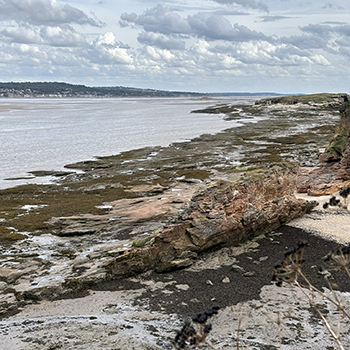
Living on the Wirral in the North West of England, a peninsula surrounded by three different waters – the River Dee, the Irish Sea and the River Mersey brings a sense of belonging, calm and purpose. The unique geography presents endless inspiration with its dramatic skies, turbulent tides, rising sandbanks and deep silted ravines – all part of the challenging and ever-changing layers of coastal living.
The landscape never stands still. Light shifts quickly across the wide estuary skies, tides redraw the shoreline, and weather moves in long sweeping patterns across the water. Observing these constant transformations inevitably filters into my work, shaping how I see colour, space and atmosphere within the landscape.
These layers are what inspire my creativity of place and provide endless ideas and exploration. Not only do they exist along the edges where land meets sea, but also within the old woodlands and winding pathways that retain the footprints of time, guiding us inevitably toward the coastline. These contrasting landscapes hold traces of mystery, evolution, and environmental change, each offering its own quiet narrative. My aim is to capture some of these elements within the constraints of a canvas or on paper, hoping to do justice to my thoughts, memories, and ideas, responding to what I see and feel.
Whether working on one of the archipelagoes in the River Dee or back on the mainland in my studio, it is invariably the changing light that captivates me – I reimagine how Turner must have felt when presented with such a landscape – the vast, sweeping skies, moody storms, weather approaching, senses that captivate the soul. But it’s also the deep shadows cast between trees, the reflections stretching across puddles – elements that draw me in. Often it can just be the sudden brilliance of light itself. All of these are symbiotic layers within the edges of land, each shaping how I respond, observe, and interpret the world around me.
Quote; “It is only when we are no longer fearful that we begin to create.” – JMW Turner.
Whether I’m working on a large scale or on small intimate pieces, I am driven to explore the very essence of connecting (or re-connecting) to a place. Maybe this comes from deep within my memories of not feeling like I belong to somewhere. I could easily paint exactly what I see – but that’s not me – that’s not my purpose – nor my true response! So I battle with ‘capturing’ fragments of light, air, movement, and memory – the very essence of the landscape.
When I do work on paper, I sometimes tear up fragments and reposition pieces to reimagine the landscape through collage. This act of layering allows for undiscovered compositions but still, the original concept remains. It also becomes a metaphor of my displaced childhood – moving from one country to another – never feeling ‘connected’ to place, only grasping fragments of my being.
Although my practice now centres mainly on painting, I often think back to a time when I worked across many different forms – from sculpture to video installation and printmaking. Each of those experiences carries a thread that runs through my work today. They are all part of me, a sense of my identity. Only now, with the benefit of distance, do I fully appreciate how valuable that period of play and experimentation was.
There is still a burning desire to reintroduce 3d elements to my work. It feels like the right time to do so. I feel my work is shifting to a more ‘personal’ level – becoming a part of my own personal history. Looking back, everything I have tried and tested now quietly supports my practice and forms the foundation of the artist I am today.

Journal #8
OBSERVATION
Working directly within the landscape allows me to witness the fleeting shifts of light and atmosphere as they unfold – the subtle movement of cloud’s, the warmth that settles just before dusk. These observations cannot be replicated from memory alone; for me they must be felt in real time.
Read more...
More than observation, however, painting outdoors is for me, a way of reconnecting. It returns me to the source of my palette and to the physical experience of place – the air, the colours, the sounds that move through a space. How do you hold the vastness of nature within a frame? How do you distil distance, atmosphere, the weight of a horizon, without losing its essence? The scale magnifies every brushstroke, every decision, exposing your ideas.
Quote: “In nature, light creates the color. In the picture, color creates the light” — Hans Hofmann.
Painting en plein air continues to be a practice I frustratingly don’t do often enough but this year, I intend to return to it more wholeheartedly – to step back into the elements and allow the landscape to lead. The intention is to continue working out on Hilbre Island, a unique Local Nature Reserve of three tidal islands, where land, sea and sky exist in constant negotiation, continuing responding to a landmark that is fragile, humble and slowly disappearing.
There is something profoundly clarifying about working out there. The isolation from the mainland is unnerving, the tidal waters cutting you off until once again, the sea retreats. Shifting tides dictate time; the wind interrupts comfort; the horizon refuses to sit still. It is a place that demands attention and rewards patience.
Beyond its natural beauty, Hilbre has evolved into a place where creativity, art, science and sustainability converge through the work of CASS – a meeting point for ideas as much as for wildlife. It is somewhere I have returned to for many years and, more recently, a landscape I feel fortunate to be part of through my involvement with the HCLT (Hilbre Community Land Trust). Supporting projects and open days that raise awareness of this fragile environment has become an important aspect of my connection to the islands. Alongside this, my role as a Trustee for BADA (British Art Design Association) allows me to help support the arts more widely – encouraging creative opportunities while remaining mindful of the responsibility that comes with nurturing these spaces and communities as they continue to grow organically. HIlbre will undoubtedly pop up often in my journals.
I can say that I am the kind of artist who needs to be surrounded by images – or, ideally, the landscape itself – allowing a visual field of ideas to gradually take shape. Working in this way naturally leads me towards a series rather than focusing consciously on a single finished piece, removing some of the pressure from both myself and the work. Not everything I produce will resonate, but the process often becomes the opening chapter of another body of work.
Because observation is so central to my practice, I often create a ‘storyboard’ to support emerging ideas – a small space I can return to whenever I need inspiration or a gentle nudge through moments of procrastination. I fill it with photographs taken while walking or researching a new site: fragments of landscape and fleeting moments, rough sketches, notes scribbled on location, poetry that resonates, references to artists who inspire me, and small colour experiments. Having everything gathered in one place allows me to dip in whenever doubt or distraction arises, often sparking ideas I didn’t realise I was searching for.
I hope that some of what I have written resonates with you, or offers reassurance that the creative mind is something to be cherished and allowed the freedom to wander. I will end this journal entry with an extract from the poem ‘Hoyle Lake’ by Anna Seward, written in 1794, taken from the book Romance of the Wirral by A. G. Caton, a poem I worked with on Hilbre.
The peopled lake, of song and lively cheer,
And boatwain’s whistle bears the joyful sound,
While rosy pennants, floating on the air,
Tinge the soft seas of glass that seep around.

Journal #7
WRITING
For me, creativeness will always be a way of processing the world. Whether through marks, painting, journals or poetry. Expression is vital in all forms. Whatever the size, each piece must hold evidence of its own becoming. This act does not always require large scale – as I described earlier, small works can carry an intimacy and intensity that feel just as powerful, sometimes even more so.
Read more...
The journey of making should remain visible – traces, markmaking, asemic writing, (a wordless, open-semantic form of writing I favour that fuses text and image, using lines and symbols that resemble writing but lack conventional meaning) and gestures – a lived conversation between surface and self. Describing nature creatively and honestly. Quote: “In all things of nature, there is something of the marvelous” – Aristotle
For some time now, I have found myself writing poems and diaries that sit quietly alongside each body of work. The poems tend to arrive unannounced – descriptive phrases forming in their own time, like written paintings. They become reflections, critical responses, rhythmic compositions that attempt to reveal the hidden layers within each piece. Where paint holds mood and gesture, poetry traces thought and feeling.
I am deeply inspired by poets such as John Clare (1793 – 1864), whose understanding of landscape and place feels instinctive and tender. In The Ramble he writes of breathing “the cool sweet air” and marking “the blue sky and all the nameless beauties limning morn” – rhythmic sensitivity to the natural world that resonates profoundly with my own way of writing. Likewise, the words of William Wordsworth (1770 – 1850) carry a timeless sincerity. In I Wandered Lonely as a Cloud, when “my heart with pleasure fills, and dances with the daffodils”, there is a purity of feeling – soulful, raw, yet beautifully restrained – that continues to move me.
I am never quite certain what I will do with my poems. They remain mostly hidden, tucked between sketchbooks within studio walls. I would not call myself a writer and certainly not a poet – only someone who occasionally needs language to speak more soulfully about a painting. Yet including fragments of these writings beside my work feels instinctively right. They offer another layer of meaning, a quiet undercurrent running beneath the surface of the paint.
My diaries on the other hand, are small snippets of observation caught in the moment, fleeting ideas, notes to self, rough sketches, references to artists I admire and ISBN numbers of books I suddenly feel I must own. They are layered with timelines, records of years passing, glimpses of thoughts, a sentence overheard, and a name circled twice so I do not forget to look it up later.
Because my art diaries are not created for anyone else to read, in truth, they will likely remain closed to the world, and I am entirely at peace with that. They are companions rather than declarations. They hold the unpolished thoughts, the doubts, the sparks of excitement – the scaffolding behind the finished work. Perhaps they are more significant than I realise. They steady me, support me, and quietly shape the paintings long before the brush meets the canvas. The Guardian quotes; “Diary-writing is the most private form of literary creation because you are both the author and (for the present at least) the sole reader”.
I love stumbling through an artist’s journal or diary and I have a particular affiliation for discovering an artist’s book that resonates with myself – that quiet thrill of finding one unexpectedly, the indulgence of bringing it home, holding its weight, turning the pages slowly. There is something deeply rewarding about that tactile exchange – paper, ink, pictures, texture – a conversation across time. To flick through and feel inspired is a kind of nourishment.
Extract from one of my own poems;
Rhythms of Colour
“Textured gestures sweeping in
Sienna Morning breaks my dreams,
A tinge of dew kissed grassy verge
Nature’s canvas connecting our means”
2025 @ Amanda Oliphant

Journal #6
PHYSICALITY
Working on a large canvas has always asked something different of me. It requires not only physical energy – the reaching, stretching, stepping back and forward again – but a certain mental expansiveness. Scale demands commitment from both body and mind.
Read more...
Scroll back to late 2024, while working on location on Hilbre Island in the Dee Estuary, off the coast of the Wirral, that physical commitment was abruptly interrupted. Whilst gathering materials across uneven silt covered ground, I fell badly and fractured my right wrist – my painting arm – in two places, and, as an added complication, also broke my shoulder. What followed was more than eight months of recovery: pain, immobility, physio and the deep frustration of not being able to paint.
This unforeseen interruption was difficult. Art is not simply what I do; it is how I process and understand the world daily. To have that taken away felt disorientating. Yet, within that enforced stillness, something quieter emerged. Although the studio initially felt out of reach, it gradually became a place of refuge. I was brought there simply to sit, to think, to read. I began writing with my left hand – tentatively at first – tapping into a different rhythm, perhaps even a different part of my brain. Ideas gathered. Plans formed.
Now, at around eighty-five per cent rehabilitated, I have returned to the canvas with renewed appreciation. The freedom of movement feels extraordinary – something once taken for granted now deeply valued. The experience has not diminished my ambition; if anything, it has sharpened it. I am working again, pushing small boundaries, but thinking big – with a heightened awareness of just how precious the act of painting truly is.
Stamina alone is not the only consideration when scaling up. There is also the practical cost of working large – the materials, the space, (as previously described, the commitment to a larger studio) and the simple fact that there is no endless supply of money. To continue, the work must sustain itself. Selling one painting becomes the quiet enabler of the next – the cold reality of an artist’s life!
Now, I am back in the studio, constructing my own stretchers and able to host workshops. It is demanding work, but profoundly grounding to paint upon a surface I have physically built. The act embeds another layer of intention before the first brushstroke is even made. Of course, scale brings its own practical choreography – manoeuvring canvases around the studio, lifting them, hanging them, (aspects that I still find difficult) transporting them to exhibitions. It is a physical negotiation with space.
Canvas is the obvious choice when scaling up as using boards would be unmanageable and working on unstretched canvas is also an option, easier to roll up and store.
A painting evolves much like a life – absorbing what has come before, shifting as it moves through space with you and balance remains the daily challenge. Maybe a metaphor of one’s own life. Layers organically accumulate within my work, sometimes unconsciously. Paintings sit beneath paintings; unresolved surfaces are reworked, buried, and resurrected – I never throw old work away as one day, I may decide to repurpose it. Being thrifty is wise not foolish!. Texture builds not only through material, but through time. If the balance is not right, the work resists being finished. You cannot simply walk away from it. It lingers, unresolved, asking for more – until something settles and the surface finally holds its own quiet resolve. Quote: “Fine art is that in which the hand, the head, and the heart of man go together.” ~John Ruskin
Journal #5
PROCESS
The process of making art can feel like navigating a minefield – it is so expansive, so versatile, with every material and method imaginable at your fingertips. Yet within that abundance, the true challenge lies in finding your own visual language.
Read more...
As mentioned previously, style does not simply appear; it reveals itself slowly, once you begin to understand your own drives, inspirations and quiet motivations – all intertwined with your personal quirks, habits and preferences. Over time, you begin to recognise your ‘you’.
What feels natural. What feels necessary. What rises instinctively from somewhere deeper, and when that alignment happens, there is a sense of contentment – a quiet knowing that what you create is honest and true.
I often find myself questioning why I became an artist. It has been a long journey of discovery, and only now do I realise—it wasn’t a choice I made; it chose me. Cliche or not, that is all I know. I believe I see things differently, accused of daydreaming as a child, I now know I was ‘deeply looking’!. I can’t imagine not doing this. How I choose colour, how colour chooses us—or perhaps, in truth, whether we ever truly choose it. Quote: “If you hear a voice within you say ‘you cannot paint,’ then by all means paint, and that voice will be silenced” – Vincent Van Gogh
Perhaps this pull to express what I see lies somewhere deep within my subconscious – an instinctive search for steadiness, for something to anchor me. Having lived abroad for all of my childhood, I absorbed different languages, customs and landscapes, yet often carried a quiet sense of displacement – as though my identity was constantly in transit.
Only recently have I begun to feel content without the persistent urge to look elsewhere. I no longer search for belonging in distant places. Inspiration surrounds me daily. I simply need to pause, to look, and to truly feel the landscape before me. That said, I still relish the occasional artist residency – the warmth of a shared creative environment, the gentle shift of perspective that comes from stepping away, if only for a while.
It has taken me years to recognise that the colours I favour are not accidental, but deeply aligned with mood and feeling. I would not describe myself as a ‘colourist’. I instinctively return to a natural palette, drawn time and again to earthy tones that feel honest and uncontrived. These muted hues carry a quiet warmth. They steady a space, soften its edges, and offer a gentle sense of connection to the land. Blue, which threads its way through much of my previous work, moves slowly – contemplative and expansive. Red, by contrast, rarely enters my paintings. It carries heat, urgency, even anger – emotions that seldom find a place within my visual language.
In many ways, my palette reveals more about my inner landscape than any subject matter ever could. There is something deeply grounding about an earthy palette. These are the tones that seem to let us exhale as we cross a threshold – colours drawn from soil, trees, seas, stone and sky that feel timeless, steadying, and quietly restorative. They do not clamour for attention; instead, they hold space.
On reflection, I’m not seeking to describe the landscape, whether in an intimate sketchbook or a vast canvas, but to distil it through process. To translate sensation rather than scenery. To allow the act of painting itself to become a quiet conversation between land and self. Quote: “When you go out to paint, try to forget what objects you have before you, a tree, a house, a field, or whatever. Merely think, here is a little square of blue, here an oblong of pink, here a streak of yellow” – Claude Monet

Journal #4
STYLE
As I mentioned in earlier journals, I was once overwhelmed – tempted by countless styles, materials and approaches. It was only through play – experimentation, missteps, doubt and discovery – that clarity began to surface.
Read more...
The failures are as important as the successes. Gradually, I reached a place of understanding – not just of technique, but of my own understanding of the way of thinking and seeing. It took time (a long time!), but that journey was essential. Finding my style was not about choosing from what was available; it was about uncovering what was already there.
When I chose to focus seriously on painting and set other distractions aside, I found myself always drawn to vast landscapes – not just from memory or observation, but from a deep sense of connection and a compelling need to express what I truly see and feel. Quote: “the aim of art is not to represent the outward appearance of things, but their inward significance” – Aristotle
I started out using acrylics, but my approach evolved after taking an oil and cold wax course in 2019. Now, I switch between both mediums depending on the series I’m working on. Acrylics give me the freedom I need, especially on a larger scale. I appreciate their responsiveness – I can work quickly, build layers, and adjust as I go. They are adaptable and facilitate running painting workshops but also make practical sense, as they are far more affordable than oils.
Over time, I have introduced drawing materials, asemic writing and some collage into my work. Stabilo pencils became a regular feature, and more recently, oil pastels. These additions allow the surface to gain depth and texture. Lines often emerge instinctively, suggesting movement, pathways, or quiet journeys across the surface. When I work with oils and cold wax, that sense of depth becomes even more pronounced, with subtle hints of underpainting seeping through to the surface. Being selective with materials, and working with intention and purpose, has become an essential part of everyday studio life.
In my paintings, I am not trying to describe the landscape literally, whether on a small or large scale, but to distil it through process (a subject to discuss further). I have always worked in series, allowing atmosphere to unfold gradually – each piece carrying an echo of the last while hinting at the next. It’s as if I don’t want that moment of exploration to end. I feel a poetic sensibility underpins much of what I do.
Analysing your own style is difficult as it emerges naturally rather than being consciously chosen. I rarely think too hard when standing in front of a blank surface – I surround myself with research material, sketches and a story board. I simply begin, knowing a landscape will emerge. Sometimes it begins from memory, sometimes from photographs I’ve taken.
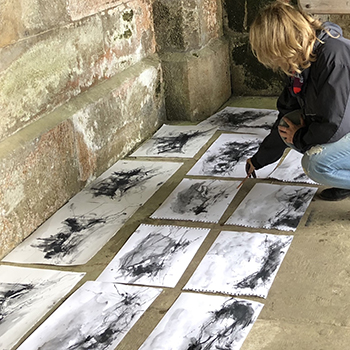
Often, I start with charcoal or a dark Stabilo pencil, making large gestural marks across the surface. Most of these will eventually be covered by layers of paint, only some surviving the process. The composition evolves as I work until I feel anchored within it, able to push it further. But often enough, if the balance isn’t right I have to walk away and return the next day. It is always a matter of knowing what to include and what to leave out – constantly asking myself, what am I trying to say, and, have I said it?
In the end, the landscape becomes inseparable from my own sense of self – an intertwining of external environment and internal reflection. In my smaller studies, I search for a sense of vastness within pieces measuring just 11 x 11 cm. I am trying to capture that fragile moment of simply being within a place – a quiet wonder that mirrors the feeling of standing within the immensity of land, light, and air. Quote: “Art is not what you see, but what you make others see” – Edgar Degas
Journal #3
GRATEFUL
I feel compelled to begin with a deep sense of relief – my new studio is no longer shadowed by the threat of redevelopment and will remain part of a collective of eight vibrant creative spaces. Each one has been shaped to nurture artists and sustain creativity within a shared environment. Finding the right studio is rarely straightforward – it is often a journey filled with compromise and uncertainty – which is why Wood Street Studios feels like a quiet treasure on the Wirral. To be part of this diverse community feels both grounding and quietly celebratory.
Read more...
My studio life has travelled through many incarnations. It began humbly in an outhouse in my back garden, then migrated into my spare bedroom. Later came the opportunity to occupy a converted industrial space in the heart of Liverpool, full of atmosphere and promise, until it too was reclaimed by redevelopment – a familiar rhythm of loss and relocation. I then found refuge in a town by the sea in what had once been a furniture restoration workshop. It carried its own character, but the damp and persistent mould slowly crept in – not ideal for art materials. A memorable experience but once again I retreated back home before temporarily settling into the attic of a friend’s garage – a kind of creative sofa surfing.
Now I am at Wood Street, a dry and spacious purpose built studio. The high ceilings, expansive walls and good lighting invites me to work at a scale that feels both liberating and slightly intimidating. It is a space where workshops unfold, paint is allowed to roam freely, and there is even a small social corner where conversations and pauses comfortably settle – something I am grateful for.
For me, the blank canvas always carries a quiet tension. Whether small or monumental, the white surface hums with possibility and uncertainty in equal measure. When working large, that silence can feel overwhelming. My instinct is to soften its starkness as quickly as possible. I begin by applying a warm wash to the surface – usually a diluted Burnt Sienna – drawn to its earthy resonance, this first veil of colour feels like an invitation. Only then do I feel able to move across the surface, allowing marks to emerge and compositions to slowly reveal themselves. There is no right or wrong in personal expression. Quote: “an artist cannot fail; it is a success to be one” – Charles Horton Cooley.
In truth, I would paint outdoors every day if I could, but the British climate has a way of testing that devotion – the cold settling deep into my hands and bones. Painting in isolated landscapes can also bring a heightened awareness of vulnerability. I recall one day in a remote woodland when an unshakable feeling of being watched settled around me. Nothing happened, yet the sensation was enough. Since then, I prefer painting plein aire in company – shared presence offering both reassurance and companionship within the landscape.
Nature remains the pulse beneath everything I create and in these winter months especially, the world feels distilled – pared back to its essential gestures. Bare branches sketch their own calligraphy against shifting skies; weather passes like breath; light slips in quietly and disappears before it can be held. I gather these fragments constantly – photographs of unsettled horizons. I am drawn to the subtle language of colour within the land: the muted earthy tones of dusk, the blue-grey hush of cold skies, the quiet warmth hidden within shadow. In my miniature paintings I collect moments before they fade, storing them like seeds, knowing they may surface again in larger paintings, transformed yet still carrying the pulse of where they began. Quote: “like painting your own reality” – Frida Kahlo
In the studio, these collected memories transform, sometimes into assemblages of nature. They are no longer direct translations but become something quieter and more introspective – recollections shaped by time and distance. Removed from their original setting, I am free to edit, simplify and transform. What is left unsaid often carries equal weight to what remains visible.
Working on a large scale continues to challenge and excite me in equal measure. It asks constant questions – what marks to hold onto, what to release, what to allow to dissolve into suggestion. Light remains my most persistent guide, often leading me towards unexpected discoveries along the way but also, the marks I apply nearing the end of its creation.
My intention is for the work to exist within an abstracted language rather than pure abstraction – an attempt to hold onto the essence, memory and emotional residue of landscape, rather than its literal form. I hope the viewer is invited to travel alongside me – to pause, to look more slowly, feeling ‘comfortably numb’ and to inhabit that same space of quiet immersion where memory and place gently converge.
Journal #2
INFLUENCES
The studio is still holding onto its winter chill, but with my trusty heaters, newly installed bright lights (worth the mention!) and a few strategically placed tropical fake plants, it almost feels warmer than being outside. Almost.
Read more...
For this second journal entry, I thought I’d share a little more about my artistic influences, processes and the thinking behind my work – so you can better understand what I do, and why I do it. I haven’t always painted, but I’ve always drawn. Sketchbooks have been constant companions – you know the kind, the ones you don’t really want to share because they feel like an extension of yourself.
My early practice was rooted in sculpture and 3D relief work. I was drawn to manipulating natural materials and influenced by artists such as Chris Drury, Anselm Kiefer, Andy Goldsworthy and Eva Hesse – all of whom create work that encourages us to see the world differently. From tree bark to 18th-century books, I would spend hours constructing tactile assemblages that became metaphors for ‘re-looking’ at the world and highlighting the fragility of nature and the unseen. Sadly, many of these works no longer exist, victims of limited storage and the delicate nature of the materials themselves.
That’s one thing that always has to be considered – the storage and management of large, fragile sculptures and paintings. Some days I wish I’d held on to a few of my finest sculptural works, but I’ve learned that as long as the process and the outcome are properly documented, that in itself is an achievement. My kids have often joked, “What will we do with all this stuff when you’re gone?” I’d love to think they’ll cherish it, though reality may suggest otherwise.
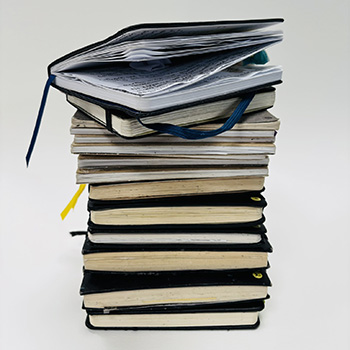
Throughout this time, drawing and documenting my processes in sketchbooks underpins everything I do (including notebooks and writing poems). Looking back, this remains a vital part of my everyday practice. Over time, as my fingers took a beating from using manual tools, I felt an increasing pull towards painting. I wanted to dive deeper, rather than skim the surface of what painting could offer. Influences such as JMW Turner, with his expressive landscapes, and more recently Joan Eardley, with her powerful visual language, drew me towards ideas of capturing expansive atmospheres, paintings that tell a story.
Around 2015, I made the decision to just paint. It’s taken ten years to feel truly comfortable with that choice and to confidently call myself a contemporary artist who paints. I’m still pushing boundaries and searching for what I want to say, through subject and the materials, but I know that when the searching stops, so should I. There has to be passion, drive and purpose – a need to keep discovering the new and the unsaid/unseen.
Some days a painting resolves itself effortlessly, reaching a point where you instinctively know it’s time to stop. On other days, it becomes a quiet struggle between thought and material. It’s always a question of balance – what to leave in, what to take away – until it finally feels ‘right’ and you’re able to walk away
That said, I do miss the physical act of ‘making’. Sculpture will always be part of who I am as an artist, and I still create small assemblages, including 3D concertina books, dotted around the studio – quiet comforts and small satisfactions. These collections of ‘things’ continue to inspire and support my current work. In time, I may reintroduce sculptural elements that sit sympathetically alongside my 2D paintings, but only when they feel meaningful. After all, you don’t have to do just one thing – as long as the body of work remains coherent and strong. Quote: Don’t think about making art, just get it done. Let everyone else decide if it’s good or bad” – Andy Warhol

Journal #1
MY STUDIO
I wanted to start 2026 a little differently – by holding myself accountable. Accountable for who I am as an artist, what I do, why I do it and how it all actually happens. This is my first journal entry, so please bear with me as I put down (and share) my feelings, thoughts, intentions, and goals – all very real parts of showing up to the studio each day.
Read more...
Getting motivated after a long break is hard. We all know the pull of winter blues – short, dark days and those long evenings that somehow make you feel guilty for not being wildly productive. Add to that the small mystery that it’s often colder inside my studio than outside (how is that even possible?), plus taking a good hour to warm it up, and motivation can wobble. Even then, I wouldn’t say it’s ever warm – more… tolerable. Throw in, the uncertainty of a change of ownership of the building can make one feel very insecure (the realities of life), but it remains my happy place. Frustrating at times but a second home, a sanctuary.
A reason for renting a purpose built studio is the ability to make large work. Nothing worthwhile comes easy, and choosing to run a studio is exactly that – a choice. People often say, “You’re so lucky to have a studio.” But it isn’t luck, it’s a risk. A risk that requires consistency, accountability and turning up even when it’s freezing. Don’t get me wrong, I’ve questioned myself plenty of times – what am I doing this for? But I know I can’t work from home. I’ve tried and failed. I know I can’t do anything else. Art is what I do – it’s who I am.
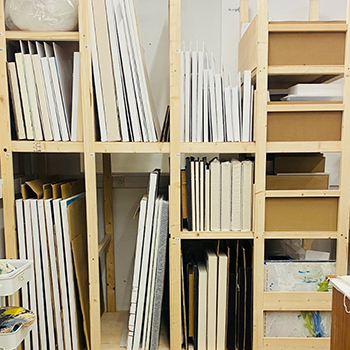
Making the studio work for me meant thinking carefully about storage and flexibility. I have a fantastic purpose-built art storage rack, plan chests, desks on wheels, material trolleys, fold-away tables (perfect for workshops) and a large painting wall. Old rugs have been a game changer for my back – artists stand far longer than we realise – and a second-hand adjustable swivel chair on wheels has been a lifesaver, especially when tackling the dreaded admin. My favourite thing though is my ‘procrastination chair’ – an old upcycled nursing chair that brings me back down to earth with a hug. We all need one of those.
Distraction is one of my downfalls. I’m inspired by other creatives, admire many art forms and love being outdoors, so when curiosity creeps in, motivation can quietly slip away and procrastination takes its place. Perhaps it’s a good thing I work alone – being an artist is a solitary vocation after all – but it’s also important to share space, meet up, and run workshops. Signing up for workshops and going on residencies has been how I’ve expanded my practice. Art is, after all, about exploration, experimentation and discovery. Along the way, I’ve learnt the value of setting reachable goals.
The studio is now wonderfully adaptable – a space for painting large or small, showing clients work, running workshops and hosting creative gatherings. It’s somewhere to hide away, or to share with like-minded people. The first half of January has been about planning the year ahead – confirming dates, filling diaries and sending off applications to Art Opens and Galleries. I won’t lie, it’s not my favourite pastime, but it’s essential and needs doing if I want my work out there in the big, bad world. So far, I’ve secured five events for 2026, which is a big achievement for me. Now I just have to deliver.
On that note, I really must get back to picking up a paintbrush – submerging myself in abstracting the landscapes that inspire me and meeting those looming deadlines. On reflection, I do work better under pressure. A deadline has a way of focusing the mind, pulling me into the studio and reminding me to do what I do best – be creative. Quote: “Creativity takes courage” – Henri Matisse


